Three Mines, Zero Housing: The Lithium Boom Headed for America's Emptiest Real Estate Market
Feb 20, 2026 · 10 min read
Three lithium mines, one remote desert, and almost no housing - where's the opportunity for real estate players?
Executive Summary
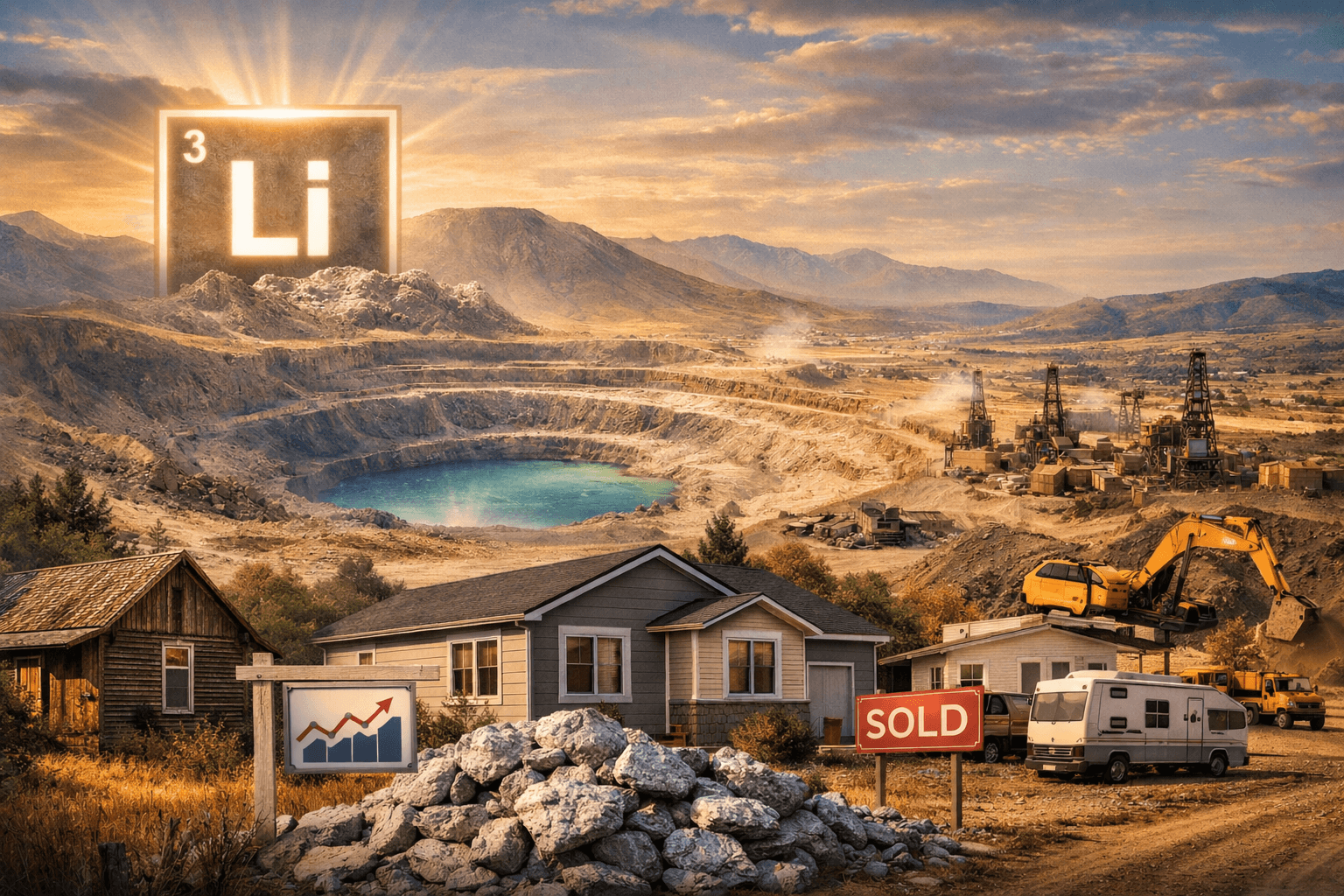
The McDermitt Caldera straddles the Nevada-Oregon border atop an estimated $1.5 trillion in lithium deposits, the largest ever identified. Three main mining operations are targeting the site. The furthest along, Lithium Americas' Thacker Pass, broke ground in 2023. The project has since locked in a $2.26 billion DOE loan and GM as a joint venture partner.
The caldera sits in a near-total housing vacuum. Parcl Labs tracked just 36 home sales within 50 miles of the caldera center over the past three years. The two surrounding counties, Humboldt County Nevada and Malheur County Oregon, combine for roughly 750 home sales per year. This is one of the thinnest residential markets in the Lower 48.
The location of the three mines funnels all workforce demand into one corridor. Only 13 properties recorded a sale within 50 miles of all three operations over three years. Orovada, a census-designated place of roughly 200 people on US-93, is the only town positioned for daily shift commutes to all three mine sites.
Extraction booms in comparable markets produced severe housing dislocations. Williston, North Dakota saw rents exceed San Francisco during the Bakken shale boom. Midland, Texas posted over 30% rent growth in a single year during the Permian Basin surge. Both markets started with more housing stock than the McDermitt impact zone has today.
Any meaningful extraction operation will generate labor-force housing demand that the existing stock cannot absorb, creating acute price pressure across both counties. We project Humboldt County home prices appreciate 28-157% over the next decade, depending on how quickly extraction scales.
This market is too small and too remote for traditional research providers to cover. Parcl Labs tracks price trends, supply dynamics, and property-level data in markets like Humboldt and Malheur County at the same granularity we bring to Miami or Phoenix. For operators, developers, and investors evaluating early-mover positioning, the data is available through the Parcl Labs Data Vault.
Three Lithium Mines, One Remote Desert
The McDermitt Caldera formed 16.4 million years ago from a volcanic collapse along the Nevada-Oregon border. For most of the past century, mercury mining and cattle ranching defined the area. That changed in 2023, when a study published in Science Advances found that hydrothermal processes had concentrated lithium in the caldera's clay deposits at levels more than double any other known claystone source on Earth. At current prices, the deposit's theoretical value exceeds $1.5 trillion.
Three companies have staked claims across the caldera, forming a tight triangle spanning 11 to 22 miles:
Thacker Pass is far ahead. LAC has roughly 700 workers on-site today and built a 2,000-room prefabricated housing facility for construction workers. But that facility houses only single construction-phase employees. Families and anyone working for Jindalee or US Critical Metals need to find housing on the open market.
That open market barely exists.
The Caldera Sits in a Housing Vacuum
Parcl Labs tracked property-level sales across both counties flanking the caldera. From January 2023 through early 2026, the two-county impact zone recorded roughly 2,300 single-family sale events across 1,946 unique properties. Monthly volume averages around 60 transactions.
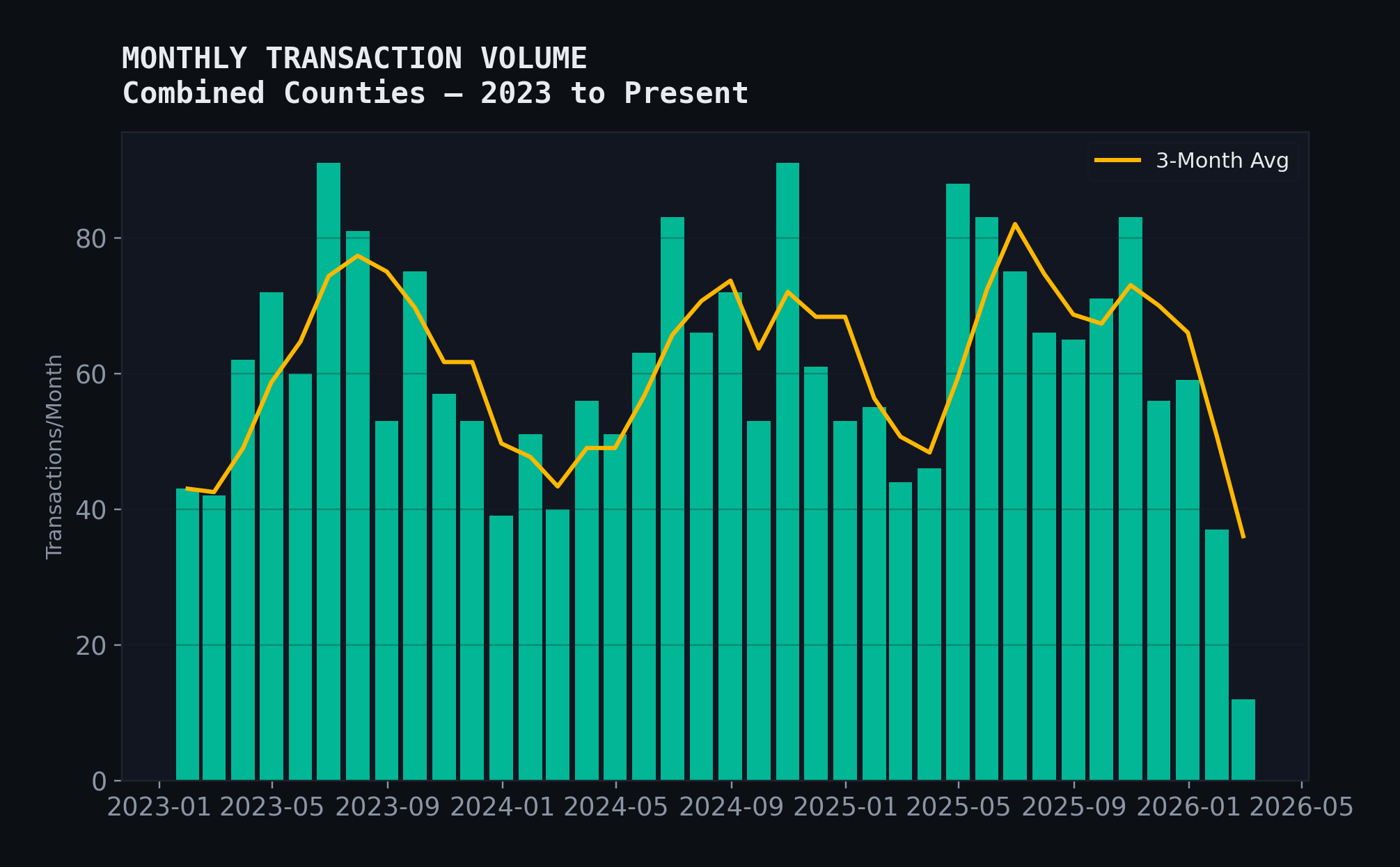
Monthly single-family sale events across Humboldt County NV and Malheur County OR (January 2023 - February 2026)
The map below plots every sale against the caldera center. The sparsity is clear - nearly all activity clusters 50+ miles out:
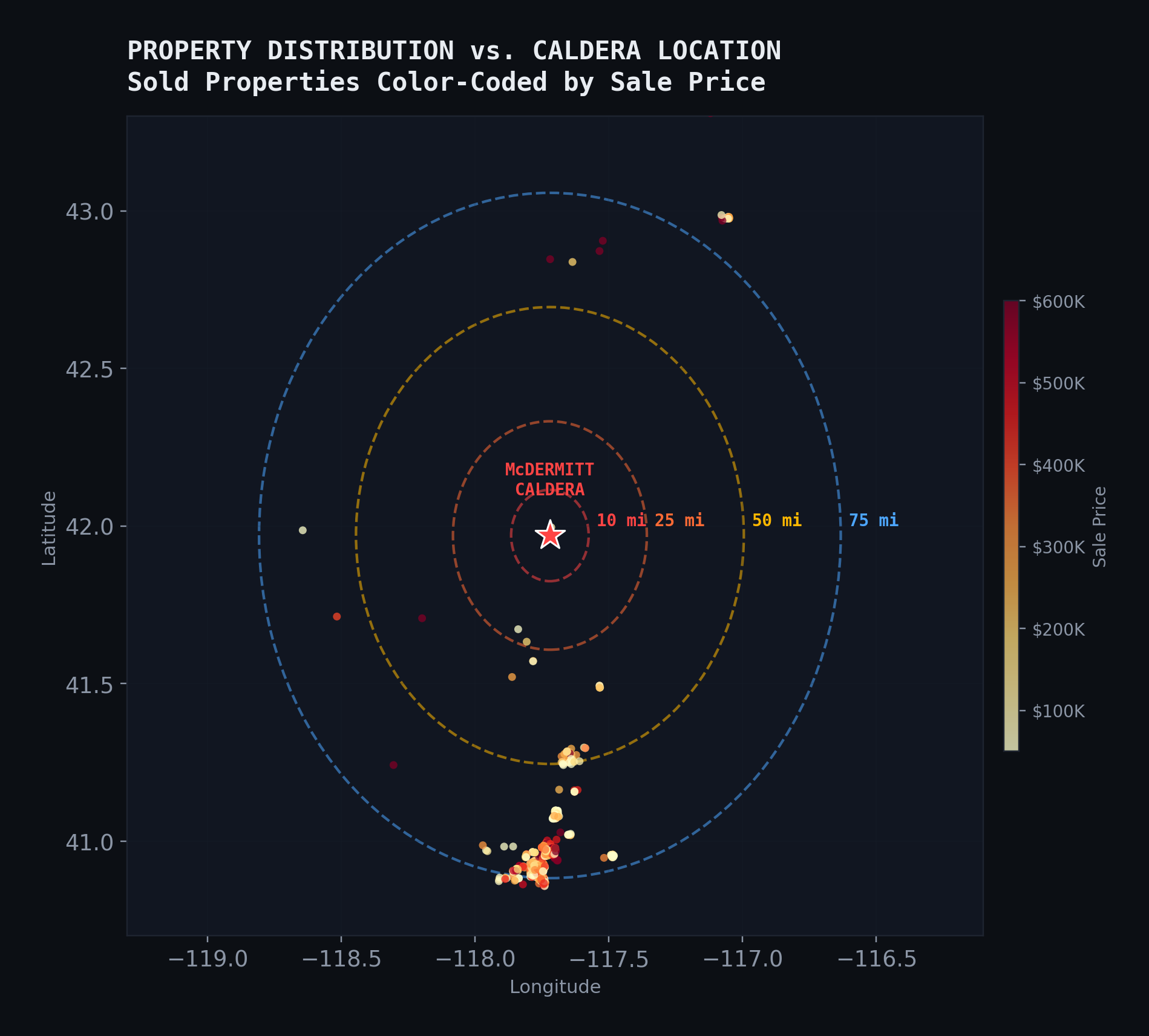
Sold properties (2023-2026) color-coded by sale price, with distance rings from caldera center
Unique properties with at least one recorded sale, by distance from the caldera center:
Distance from Caldera Center | Properties with Recorded Sales |
|---|---|
0-10 miles | 1 |
10-25 miles | 2 |
25-50 miles | 34 |
50-75 miles | 894 |
75-100 miles | 81 |
Fewer than 40 properties traded within 50 miles over three years. Combined population in the four named places within that radius (Orovada, Paradise Valley, McDermitt, Denio) sits under 1,000 people. The nearest cluster with real housing density is Winnemucca, 75 miles south, home to the majority of Humboldt County's 17,000 residents.
What stock does exist is modest. Median sale price across both counties: $285,000. Median square footage: 1,477. Three-bedroom homes account for nearly half of all transactions. Most date to 1990 or earlier, with the largest construction cohort from the 1970-89 period, built during earlier mining and ranching cycles. Post-2010 construction barely registers.
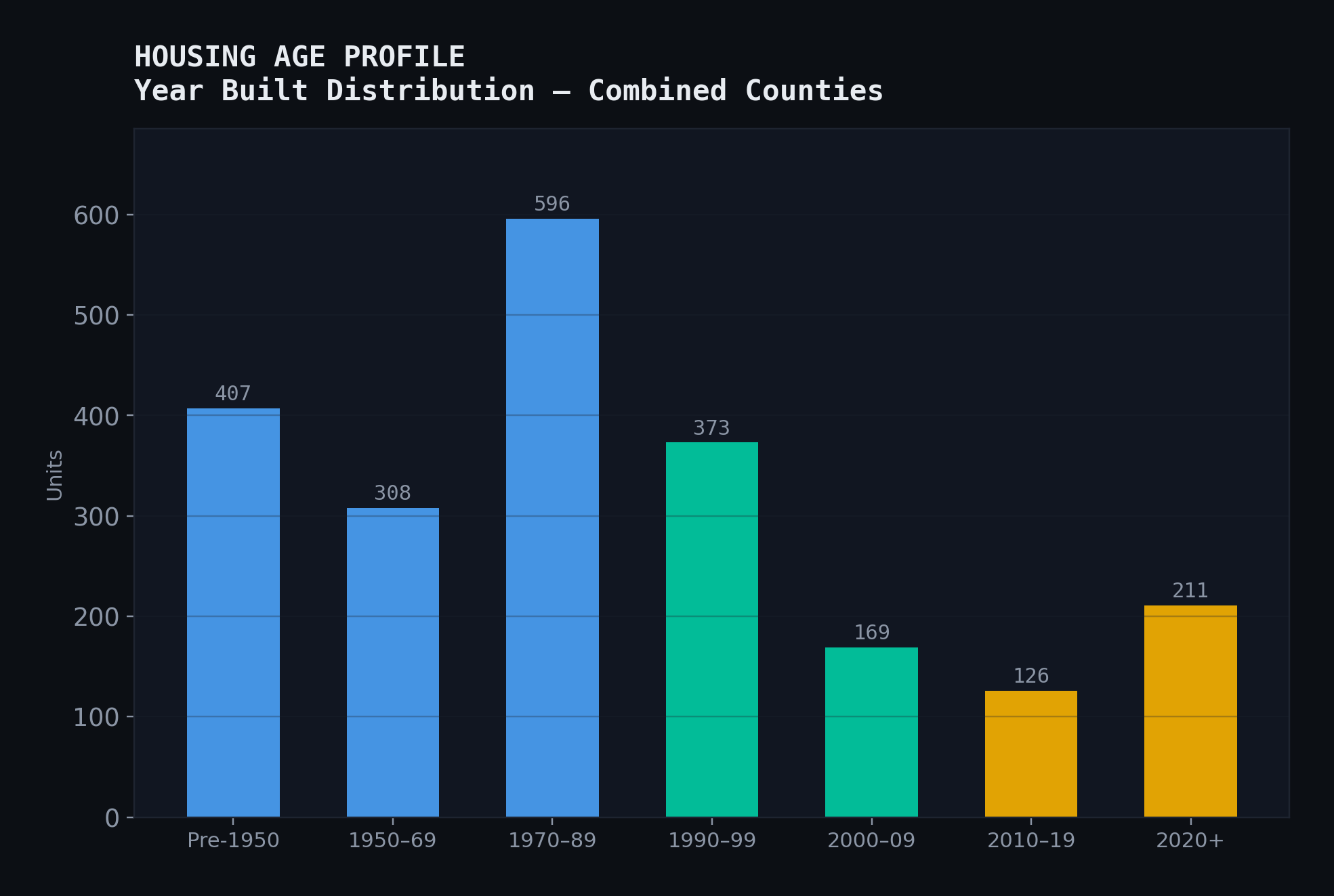
Year-built distribution across 1,946 properties — the 1970-89 cohort dominates, reflecting earlier mining and ranching cycles
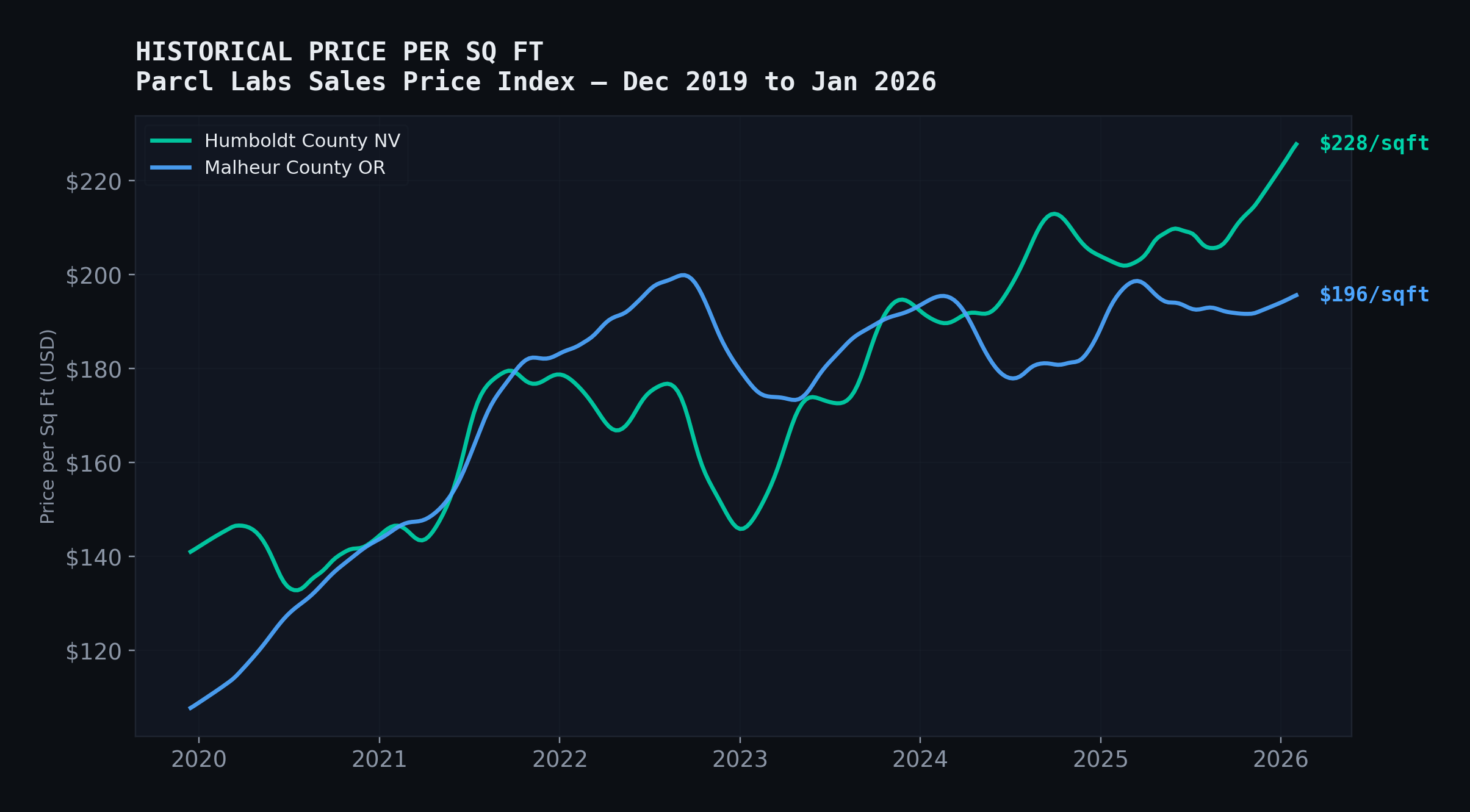
Humboldt County NV: $228/sqft | Malheur County OR: $196/sqft (January 2026)
Current ownership flags across the 1,946 properties show 55% owner-occupied, 8% investor-owned, and 37% classified as other or unknown. Institutional investor presence is effectively zero. Speculative capital hasn't arrived yet - a pattern that typically shifts early in an extraction cycle.
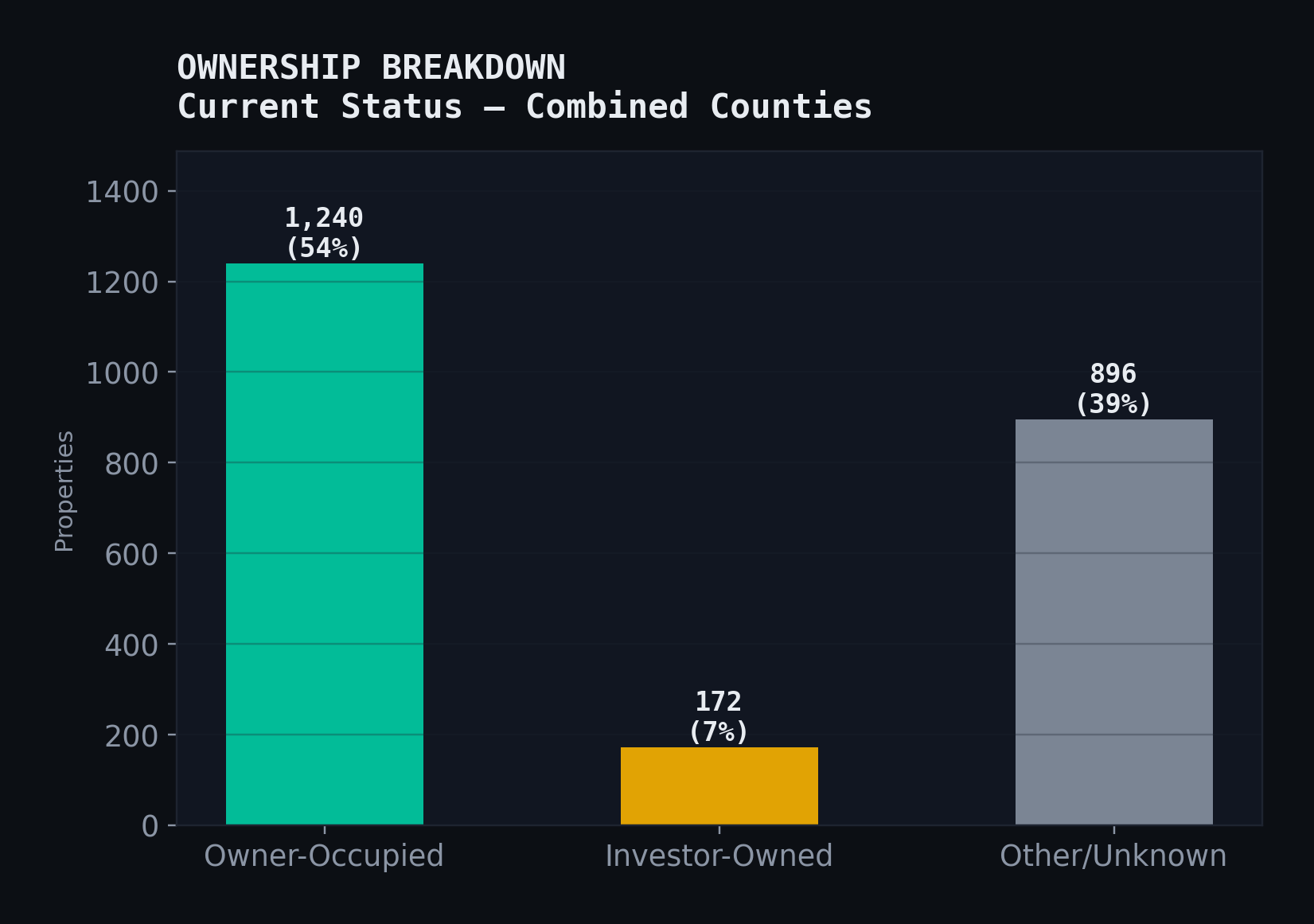
Owner-occupied (55%), investor-owned (8%), other/unknown (37%) — institutional presence is near zero
Past Booms Show What Could Come Next
Major resource discoveries have landed in housing-scarce areas before. Patterns from prior booms are instructive.
Williston, North Dakota doubled in population from roughly 15,000 to over 30,000 between 2010 and 2013 during the Bakken Shale surge. At the peak, 700-square-foot apartments rented for $2,394/month, more than San Francisco, New York, or Boston at the time. Workers with jobs slept in vehicles because nothing was available.
Midland-Odessa, Texas tells a different version of the same story. A larger metro of ~160,000 with more existing housing still couldn't absorb the Permian Basin demand. Rents spiked 41.6% in 2017, the fastest growth in America that year.
Both markets started with more housing stock than the McDermitt impact zone has today. The pattern is consistent: housing pressure arrives in months, construction takes years to respond, and the gap between the two is the period of maximum price pressure.
Three Mines Funnel Into One Corridor: Where to Build
Thacker Pass alone could stress this market. Three operations compound the math.
When you overlay 50-mile buffers from all three mine sites, only 13 properties recorded a sale within range of all three simultaneously. Expanding to 75 miles captures 439, but most of those properties are in Winnemucca, which sits 54 to 74 miles from the mine sites. That's a marginal daily commute for shift workers.
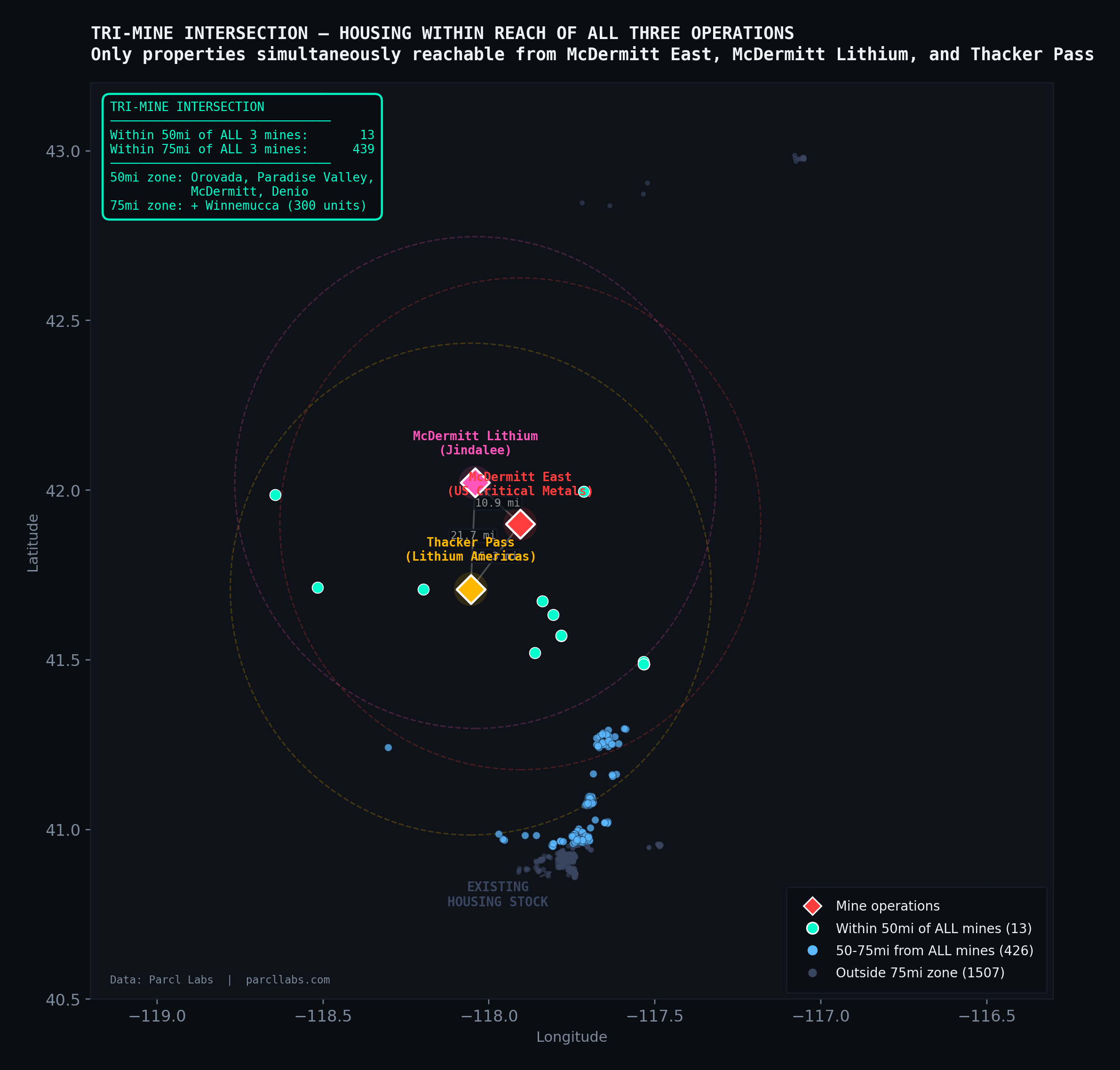
Sold properties simultaneously reachable from McDermitt East, McDermitt Lithium, and Thacker Pass
The tight geometry creates a specific question for developers: where can you build housing that serves all three mines via existing roads?
Straight-line distance from every town along established highway corridors to each mine site:
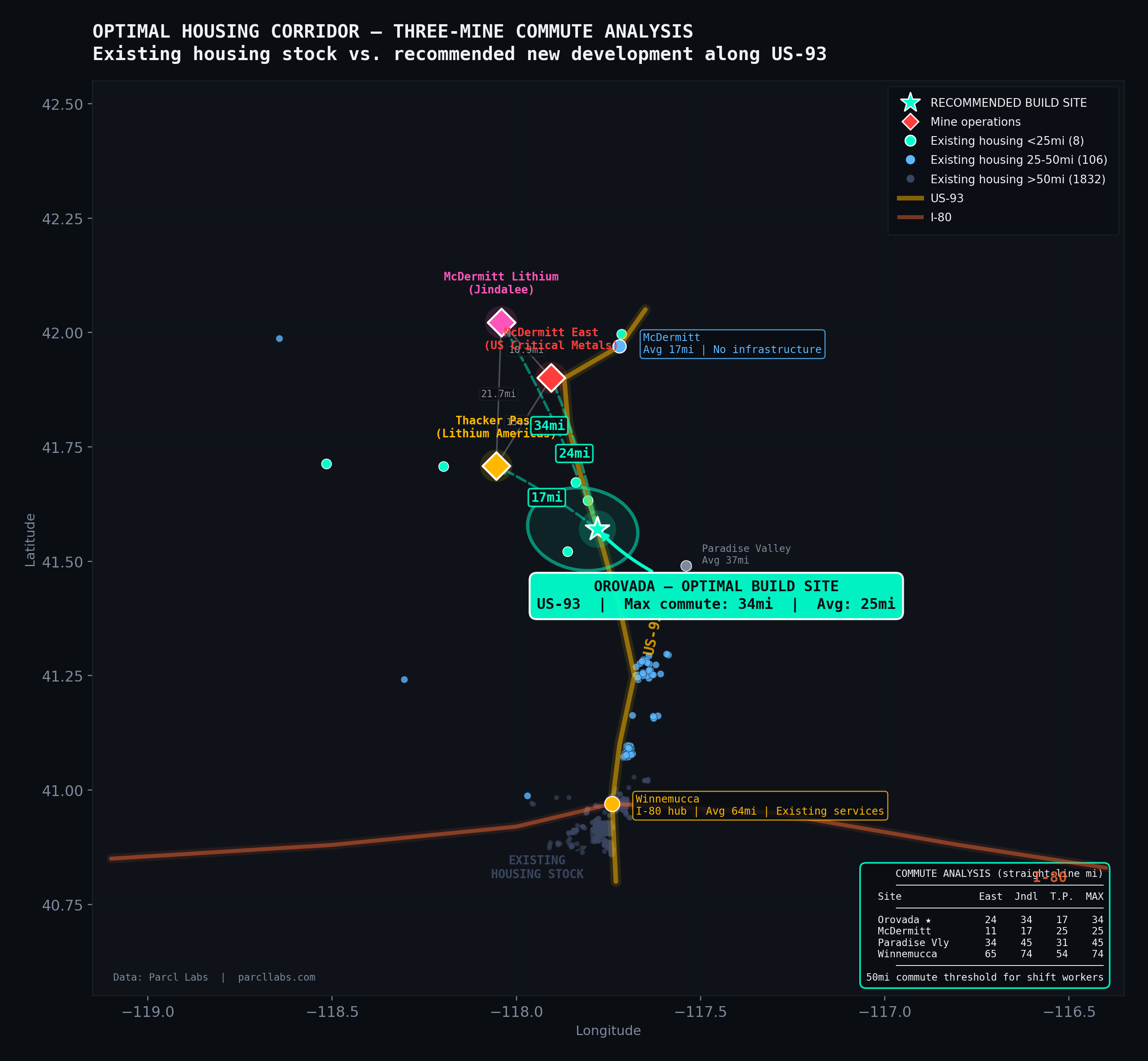
Straight-line distance from highway corridor towns to each mine site - Orovada minimizes maximum commute across all three
Orovada, on US-93, is the clear answer. Seventeen miles to Thacker Pass, 24 to McDermitt East, 34 to Jindalee. Maximum commute: 34 miles, roughly 30-40 minutes on rural highway.
McDermitt has the lowest average distance at 17 miles (practically on top of two mines) but it's a community of roughly 200 people with limited services. Paradise Valley is a reasonable alternative but sits on NV-290 rather than the US-93 spine, with a 45-mile max commute to Jindalee.
Winnemucca has the services: I-80 access, a regional hospital, schools, retail. But the commute distances make it a regional support hub rather than a primary bedroom community for shift workers.
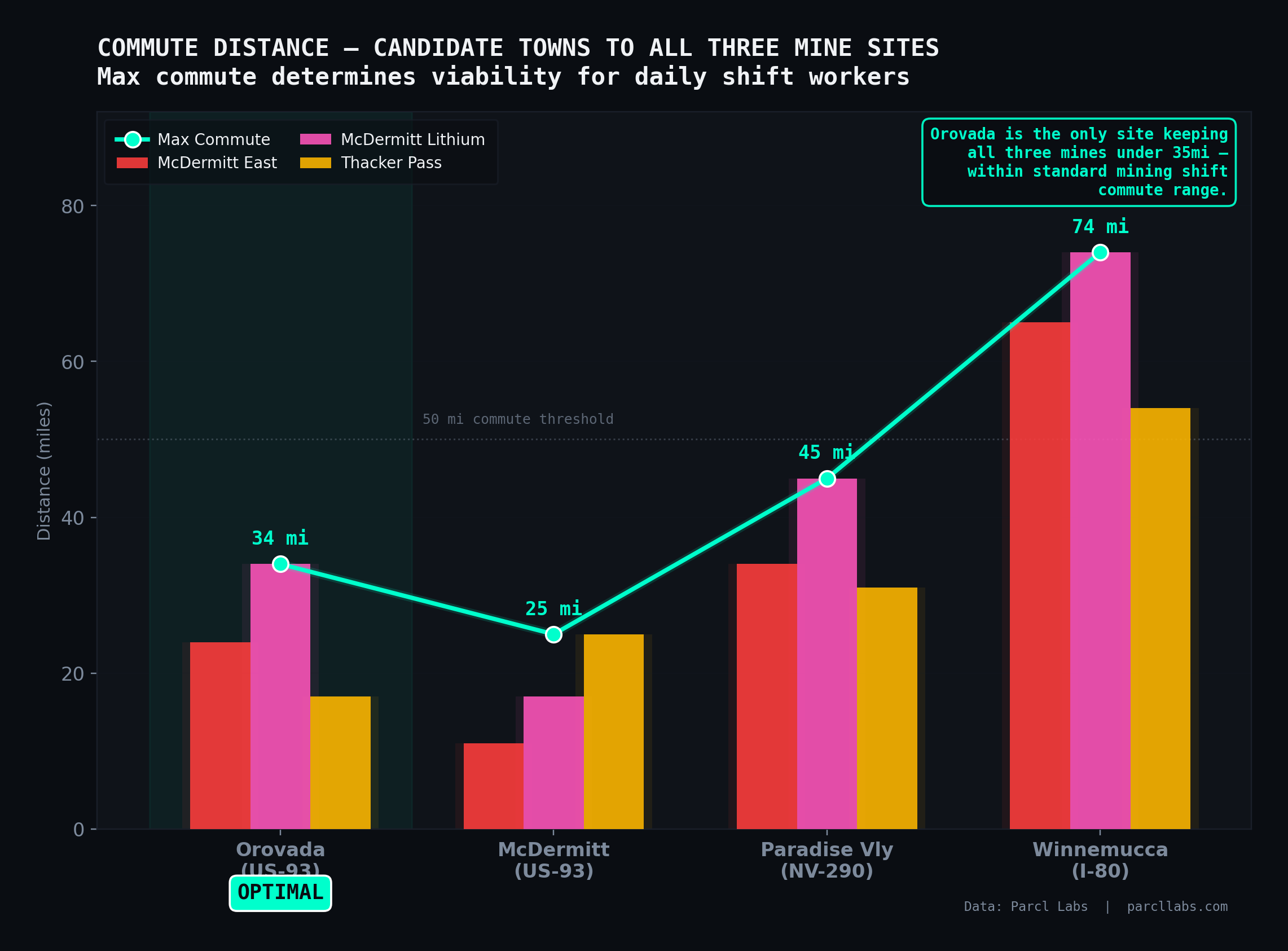
Distance from each candidate town to the three mine sites - Orovada's 34-mile max falls well within standard mining commute range
Up to 157% Price Growth Over the Next Decade
Three scenarios bracket the range of outcomes for Humboldt County, using Parcl Labs' price index as a baseline and grounding each trajectory in actual analogues.
The boom scenario (+10%/year) pushes price/sqft to $587 by 2036, a 157% increase. This tracks the Williston/Midland pattern: rapid extraction ramp-up, labor influx of 3,000+ workers across all three operations, speculative land acquisition. Both Williston and Midland saw price growth exceeding this rate during peak years.
The moderate scenario (+6%/year) reaches $407 by 2036, a 78% increase. This maps to sustained mining dynamics: phased extraction over 5-7 years, steady workforce demand, housing construction that responds but lags. LAC's 2,000-room workforce hub absorbs some construction-phase demand, dampening the initial spike.
The baseline scenario (+2.5%/year) lands at $291 by 2036, a 28% increase. Permitting delays, water rights complications, or a commodity price correction stalls development. Normal rural appreciation continues.
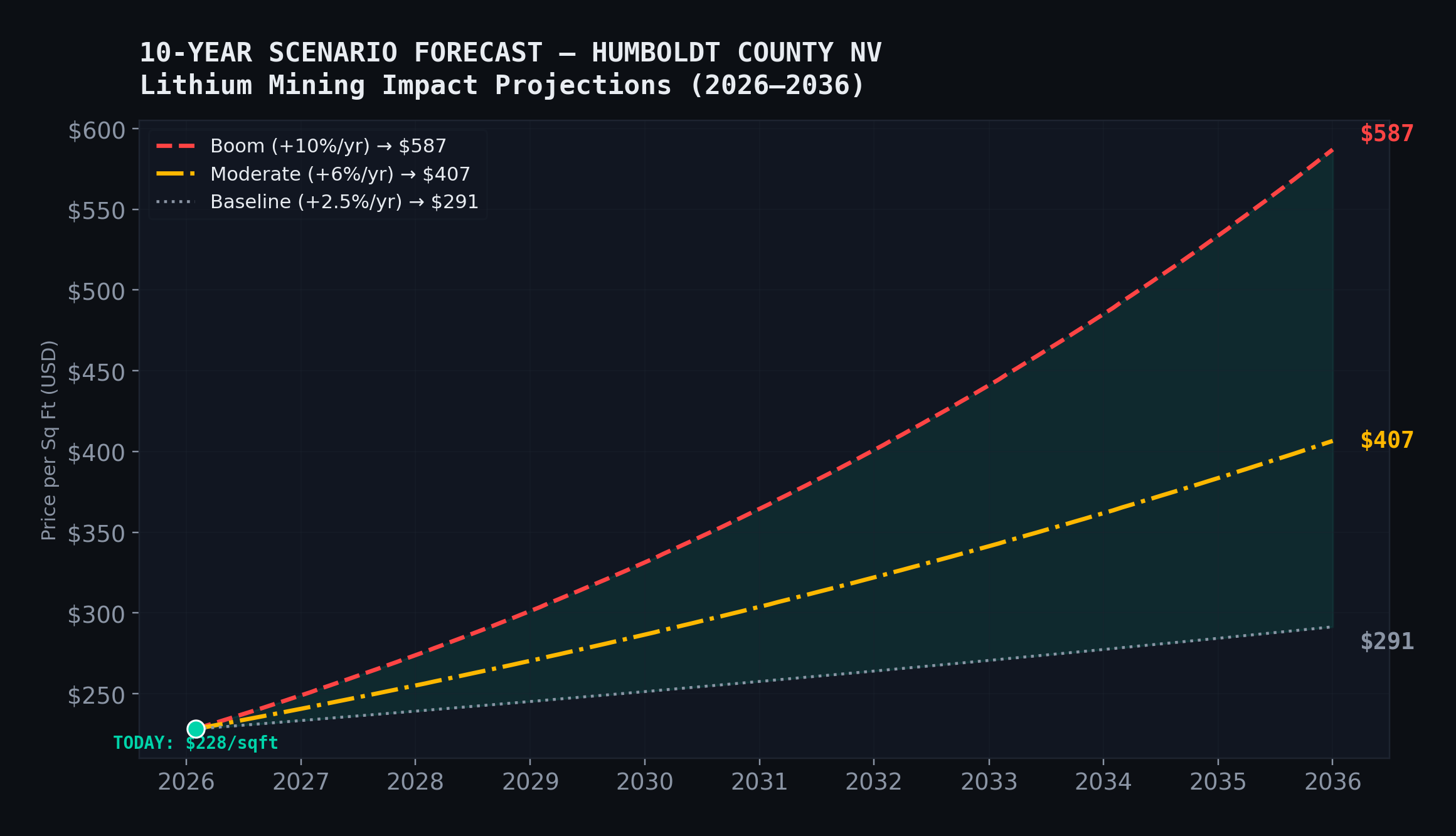
Compound annual growth projections from $228/sqft baseline (January 2026)
The moderate scenario deserves the most weight. LAC's DOE-backed financing and GM joint venture provide substantial downside protection for Phase 1. The workforce hub will absorb the bulk of construction-phase labor directly. But the hub houses only single workers; families must find housing independently in Winnemucca or surrounding areas. And the hub doesn't serve Jindalee or US Critical Metals workers at all.
Who's Exposed and Where the Opportunity Sits
Developers and operators should be looking at the Orovada corridor along US-93. It's the primary buildable zone for workforce housing that serves all three mine sites. Land costs in Humboldt County are cheap; the constraint is infrastructure, not acreage. Whoever builds first captures the initial demand wave. Prior extraction booms saw +2x rental rates over the boom period.
Investors face a different calculation. The 50-mile intersection zone recorded just 13 home sales in three years - there is almost no existing homes to transact. Land is a different story. Humboldt County acreage is available and cheap relative to most Western markets, and institutional capital hasn't arrived yet. In comparable booms, the window between early positioning and priced-in was narrow.
Existing homeowners within the impact zone hold equity upside under any scenario where extraction proceeds. Owner-occupied properties in the 25-50 mile ring are positioned for the steepest appreciation given both scarcity and commute viability.
Methodology
Parcl Labs generated all property-level data, analysis, and research cited in this article.
Property data: Parcl Labs property-events dataset, single-family sales, January 2023 through February 2026. The dataset contains 2,308 sale events across 1,946 unique properties in Humboldt County NV (Parcl ID: 5821019) and Malheur County OR (Parcl ID: 5820653). Distance ring counts and property-level statistics are computed from unique properties. Transaction-level statistics (median sale price, monthly volume) use all recorded sale events.
Price index: Parcl Labs daily sales price feed ($/sqft), December 2019 through January 2026.
Geographic analysis: Haversine distance calculation from caldera center (41.97N, 117.72W) and from each of the three mine sites. Mine coordinates: McDermitt East (41.901, -117.906), McDermitt Lithium (42.022, -118.041), Thacker Pass (41.708, -118.055). Road distances will be 10-20% longer than straight-line calculations. Distance ring counts represent unique properties with at least one recorded sale during the analysis period. Total housing stock in each zone is somewhat larger than these counts, as properties that did not transact during 2023-2026 are not captured.
Scenario modeling: Compound annual growth rate projections benchmarked against documented housing price movements in analogous extraction-boom markets (Bakken Shale/Williston ND, Permian Basin/Midland TX, Pilbara WA, Carlin Trend/Elko NV).
Ownership classification: Based on Parcl Labs current-owner flags at the property level.
Parcl Labs tracks price trends, supply dynamics, and property-level events in markets like Humboldt and Malheur County at the same granularity available for major metros. The data is available through the Parcl Labs Data Vault, or reach out at team@parcllabs.com for custom research.

Follow Us for More