Homebuilder Earnings Show Demand Exists - At the Right Price
Aug 11, 2026 · 6 min read
What Recent Homebuilder Results Tell Us About The Housing Market
With 2Q26 homebuilder earnings largely complete, we are taking a closer look at trends from the quarter to better understand what builders are seeing on the ground.
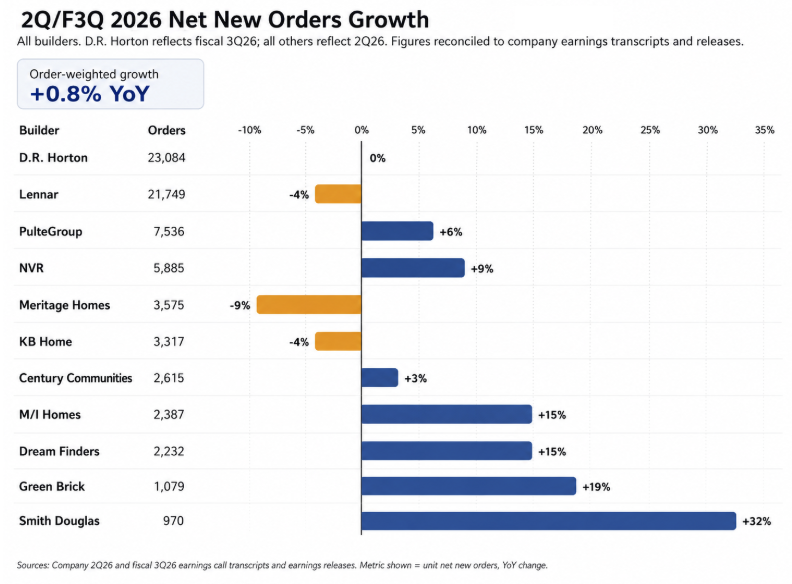
Generally speaking, order growth held up reasonably well. On a volume-weighted basis, orders across the major public builders were essentially flat, up roughly 1% YoY. Order growth was disproportionately concentrated among smaller, more affordability-oriented builders. The smaller five in our sample grew orders roughly 13% YoY, while the top six were slightly negative - another indication that demand exists when builders can meet buyers at an affordable price point.
Regional trends were mixed, but weakness was generally more pronounced across the West, Southwest and parts of Texas, where higher levels of new-home supply are creating greater competition on price and incentives. The Northeast and Midwest appeared more resilient, where tighter inventory has limited some of the pricing pressure required to generate demand.
The broader takeaway is that demand remains available across most regions, but the clearing mechanism differs. In tighter-supply markets, builders are seeing relatively resilient volume with less pressure on price. In higher-inventory markets, particularly parts of the Sun Belt and West, builders are having to work much harder to generate the same demand.
Chart 1. 2Q26 Order Trends
Thematically, management commentary pointed to a weaker selling season and a challenging setup as builders balance maintaining volume with the pricing needed to clear inventory.
Demand is still there, but affordability remains the key constraint - buyers need a lower monthly payment to transact. As a result, management teams are using a combination of lower prices, mortgage buydowns and incentives to maintain sales pace and keep inventory moving through the system, with the hope that the demand environment becomes more constructive on the other side.
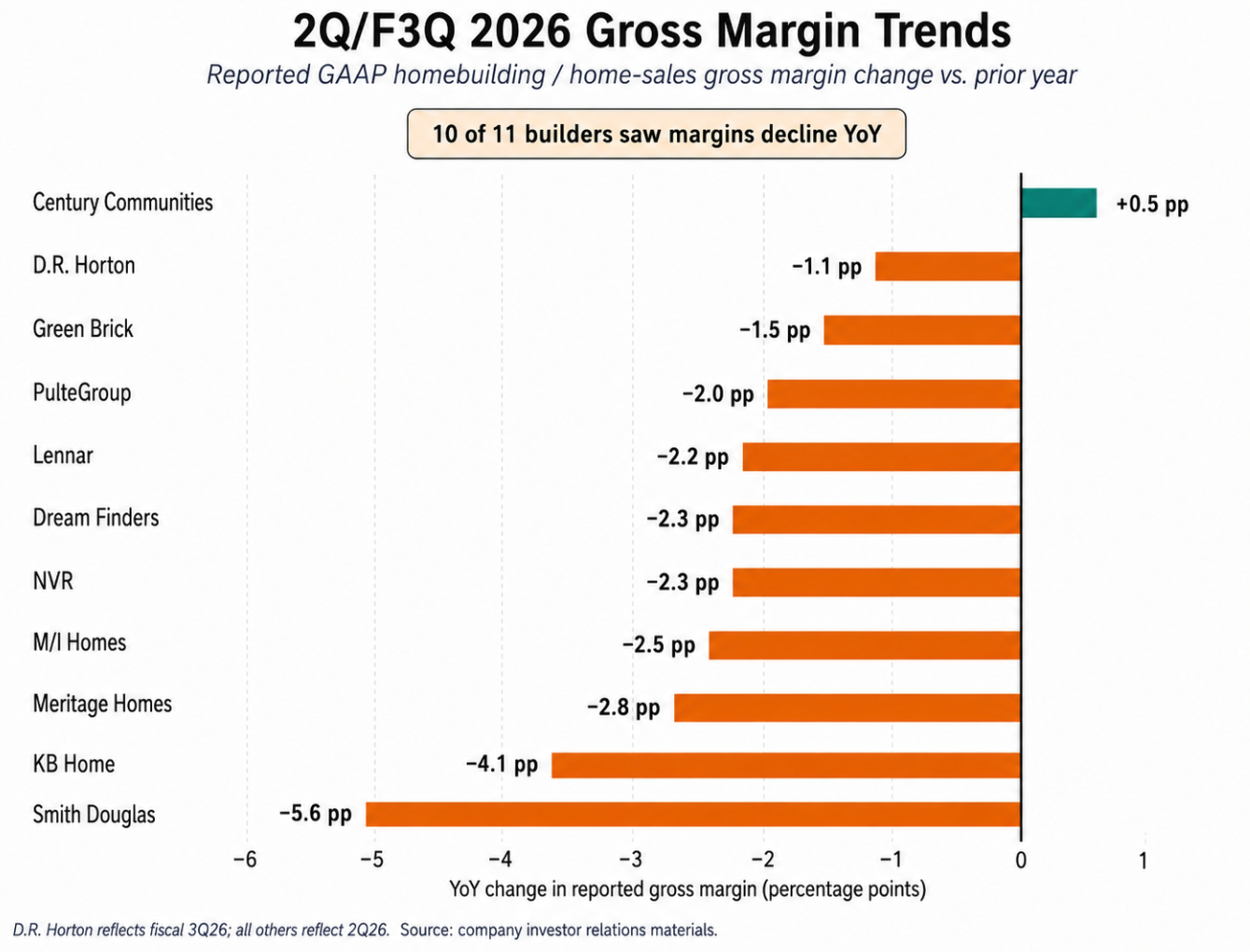
The result is broad margin compression on a year-over-year basis. Ten of the 11 builders in our sample reported lower gross margins than a year ago, with Century Communities the lone exception. Lower pricing and affordability incentives are absorbing a meaningful portion of the economics required to maintain sales pace.
Chart 2. 2Q26 Margin Trends
Different Strategies, Same Affordability Problem
Across the group, builders recognize that the current monthly payment remains too high for a meaningful portion of buyers. The challenge is balancing sales pace with profitability per home.
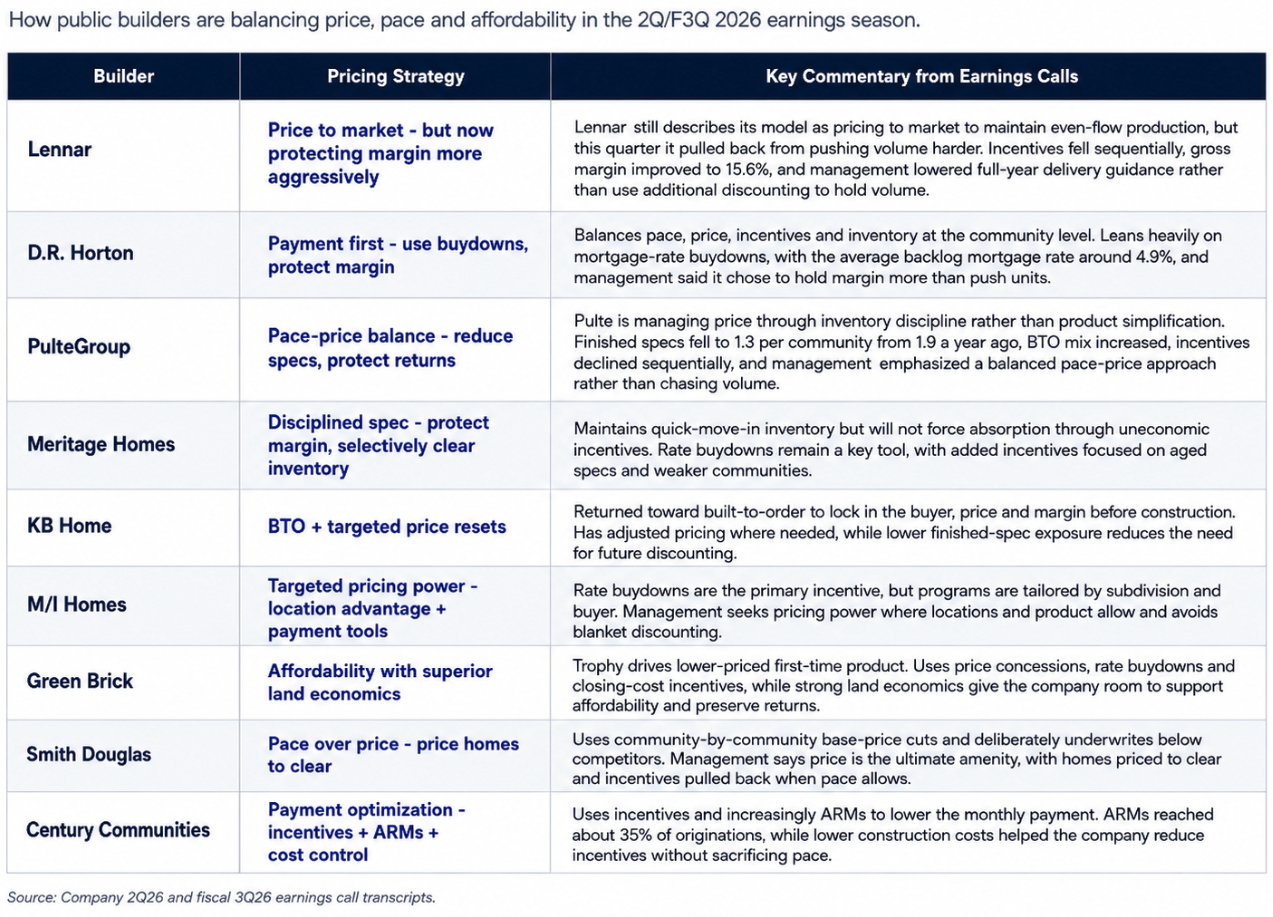
How they are solving that problem varies considerably. Lennar continues to price to market, but in 2Q showed greater willingness to protect margin rather than push incremental volume. Smith Douglas remains the clearest pace-over-price operator, pricing homes to clear from the outset. D.R. Horton, M/I Homes and Century lean more heavily on financing tools to solve for the monthly payment. Pulte is using tighter spec management and a higher built-to-order mix to protect returns, while KB is similarly leaning into BTO to reduce future discounting risk. Meritage is maintaining its quick-move-in model but is deliberately accepting slower absorption where additional incentives would become uneconomic. Green Brick continues to benefit from favorable land economics, giving it more room to support affordability while preserving returns.
The chart below summarizes the pricing strategies and key commentary from recent public builder earnings calls.
Chart 3. Homebuilder Pricing Strategies
Homebuilder Tracker and Motivated Seller Scores
The listing data broadly supports what builders are telling investors, while also highlighting where listing behavior differs from management's stated pricing strategy.
Several builders are showing very high levels of listing motivation, including Pulte, Meritage, Lennar and Century. Lennar's 8.63 Motivated Seller Score is consistent with its broader price-to-market philosophy, although 2Q commentary showed greater willingness to protect margin rather than push incremental volume. D.R. Horton and KB Home are showing less aggressive listing behavior as they rely more heavily on financing tools and built-to-order production.
There are also notable divergences. Pulte's current listing behavior is among the most motivated in the group despite management emphasizing a balanced pace-price approach, lower spec inventory and disciplined returns. Smith Douglas illustrates the opposite dynamic.
Importantly, the Motivated Seller Index measures listing behavior, not the total economic discount a builder may be providing to the buyer. Builders can also solve affordability through mortgage buydowns, closing-cost assistance, initial base pricing and other incentives that may not show up as subsequent listing price reductions.
Smith Douglas is a good example. Management explicitly operates with a pace-over-price philosophy, but it also attempts to price homes near the clearing price from the outset. As a result, a lower Motivated Seller Index does not necessarily mean the company is less aggressive on price. It may simply have less need to make subsequent listing reductions.
Across the builder universe, the Parcl Labs Motivated Seller Index stands at 7.92, roughly 2.5 points above the broader U.S. market, highlighting how aggressively builders are competing for today's affordability-constrained buyer.
Builder | Pricing strategy from earnings | Parcl Motivated Seller Score | Read | What the MSI says |
|---|---|---|---|---|
Pulte | Pace-price balance - reduce specs, protect returns | 9.26 | Fire Selling | Current listing behavior remains among the most motivated in the group despite management emphasizing inventory discipline and a balanced pace-price approach. |
Meritage | Disciplined spec - protect margin, selectively clear inventory | 9.18 | Fire Selling | Consistent with a quick-move-in model where incentives and repricing are used selectively to keep spec inventory fresh while avoiding uneconomic absorption. |
Lennar | Price to market - but greater margin discipline in 2Q | 8.63 | Fire Selling | High listing motivation fits Lennar's price-to-market philosophy, although management pulled back from pushing incremental volume this quarter as incentives declined and margins improved. |
Century | Payment optimization - incentives + ARMs + cost control | 8.69 | Fire Selling | Despite declining incentives in the quarter, current listings remain highly motivated, suggesting pricing pressure remains meaningful at the community level. |
KB Home | BTO + targeted price resets | 6.9 | Motivated | Fits the strategy. KB has reset prices where necessary, while a higher BTO mix reduces the need to continually reprice finished inventory. |
D.R. Horton | Payment first - use buydowns, protect margin | 6.16 | Motivated | Consistent with commentary. Horton is relying more heavily on financing incentives and has shown greater willingness to protect margin rather than push incremental units. |
Smith Douglas | Pace over price - price homes to clear | 5.72 | Motivated | The lower MSI is consistent with its strategy. Smith Douglas starts near the clearing price, reducing the need for repeated listing cuts even though its underlying pricing posture is aggressive. |
Taken together, 2Q results and listing data point to the same conclusion: housing demand has not disappeared, but buyers remain highly sensitive to price and monthly payment. Builders are finding demand when they can solve the affordability equation, whether through lower base prices, financing incentives, product mix or inventory strategy.
Follow Us for More