The Unexplained Rise in Anonymous, All-Cash Home Buying Near U.S. Research Facilities
Oct 4, 2026 · 6 min read
Anonymous, all cash buying of residential housing around semiconductor fabs, space and aerospace defense centers, and nuclear research labs is on the rise.
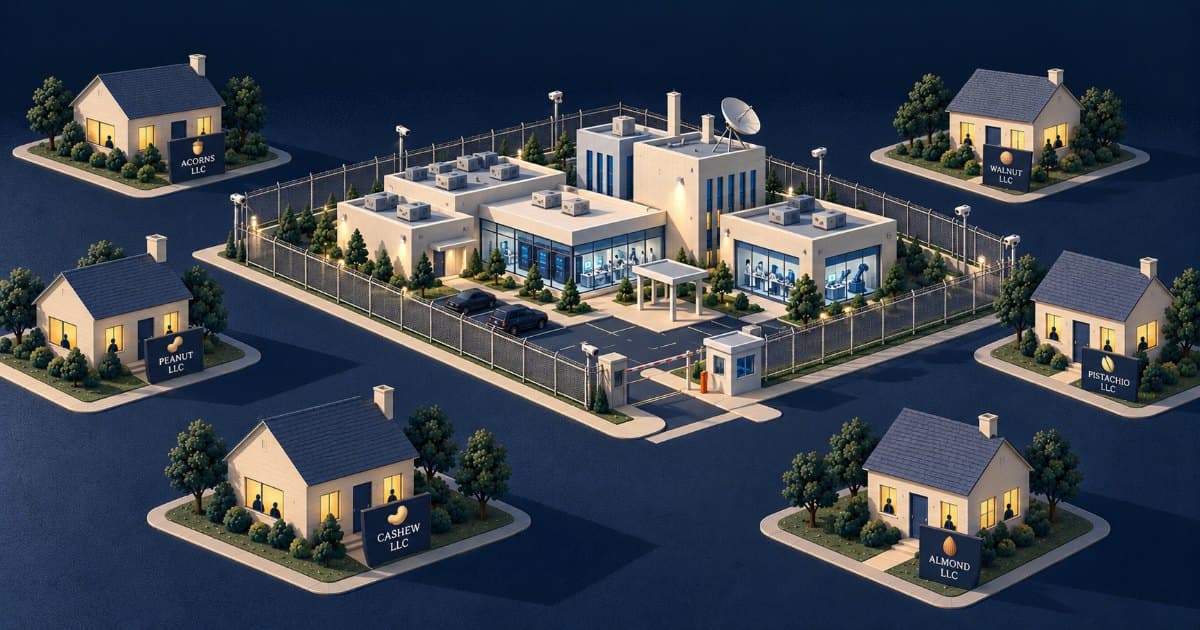
I found a pattern in the housing market that I can’t explain.
Since 2019, anonymous LLCs new to the housing market have been buying a growing share of homes near 75 research and development facilities across the United States, almost always with cash. The sites include semiconductor fabs, space and aerospace defense centers, and the national labs behind nuclear research and deterrence. The trend reached its high in 2025.
Who are these buyers? In 2024 through September 2026, they made 4,264 home purchases within 5 miles of research facilities. Of those buyers:
- 96% had made their first recorded home purchase within the previous six months.
- 88% paid all cash.
- 68% use numbered or otherwise opaque LLC names.
How much more common is this near R&D sites? In 2024-26, anonymous LLCs made 1.33% of home purchases within five miles of a research facility. That compares with 0.84% near major military bases and 1.03% across the broader market. That makes this buying 1.6 times as common near research facilities as near military bases and 1.3 times the broader market.
1.33% may seem small, and on a proportional basis it is. But this is the kind of activity that would draw national attention long before it reached a large share. What matters is the direction: near these R&D facilities, the share has risen faster than in the surrounding area, and that rise is unlikely to be chance when compared with matched control locations (p = 0.03). Near military bases and across the national market, the share sits lower and has risen more slowly.
And it’s growing. Since 2019-2022 their share near research facilities has risen 40%, from 0.94% to 1.33% of purchases. Over the same period it rose 29% near military bases and 23% across the broader market.
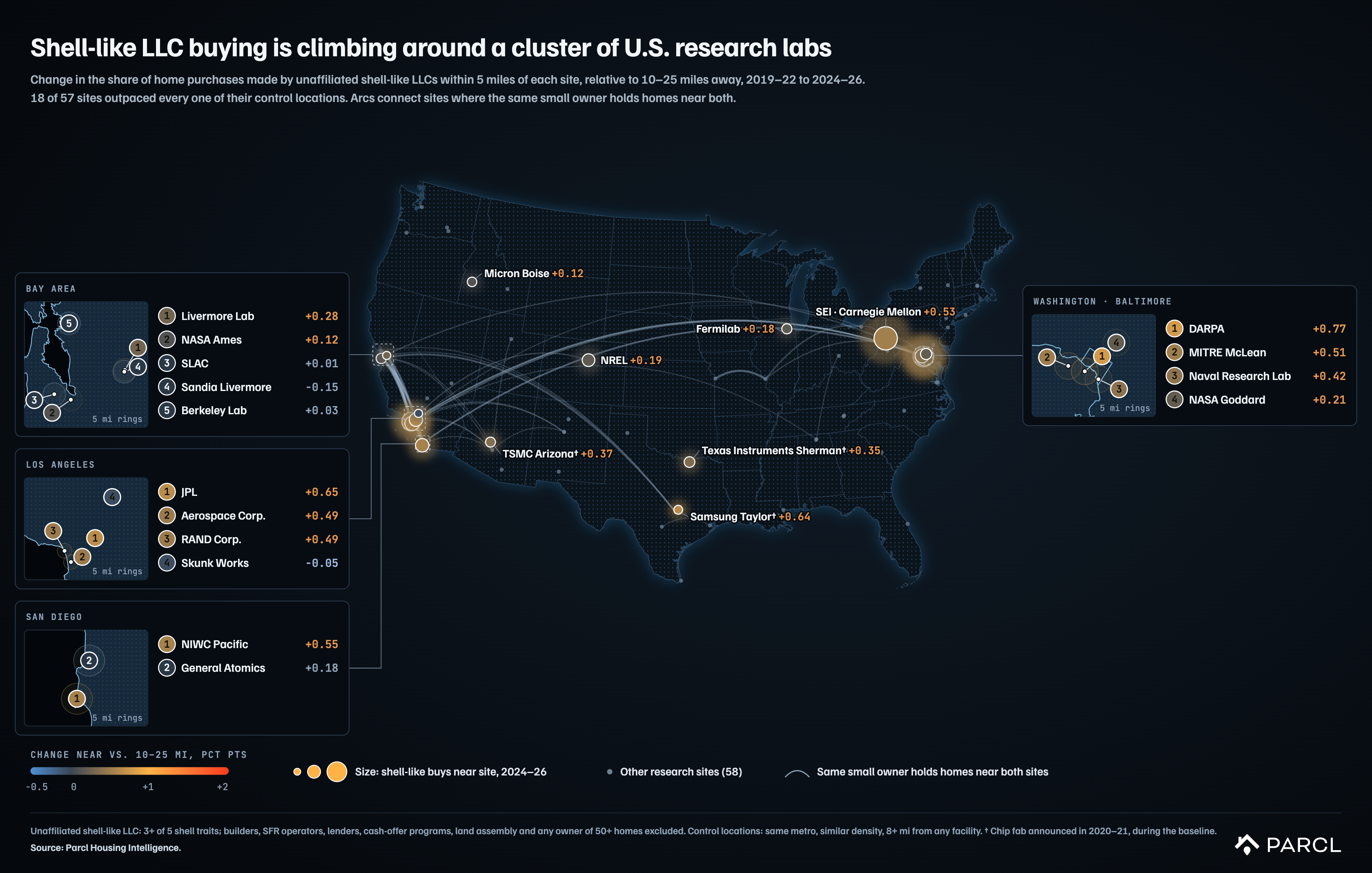
To control for the market dynamics that come with where R&D facilities happen to be located, I compared buying in each facility's immediate surroundings (within 5 miles) with buying in the same market further out (10 to 25 miles away). I then ran the identical comparison on 271 control locations in the same metros with similar housing density profiles.
Near research facilities, anonymous LLC buying climbed from about the same rate as the surrounding area in 2019 (1.01 times) to 1.38 times in 2025. At the matched control locations it held flat at about 0.8 to 0.9 times. Comparing 2019-22 with 2024-26, the near-facility measure rose 0.16 while the control moved 0.01, a difference unlikely to be chance (p = 0.03).
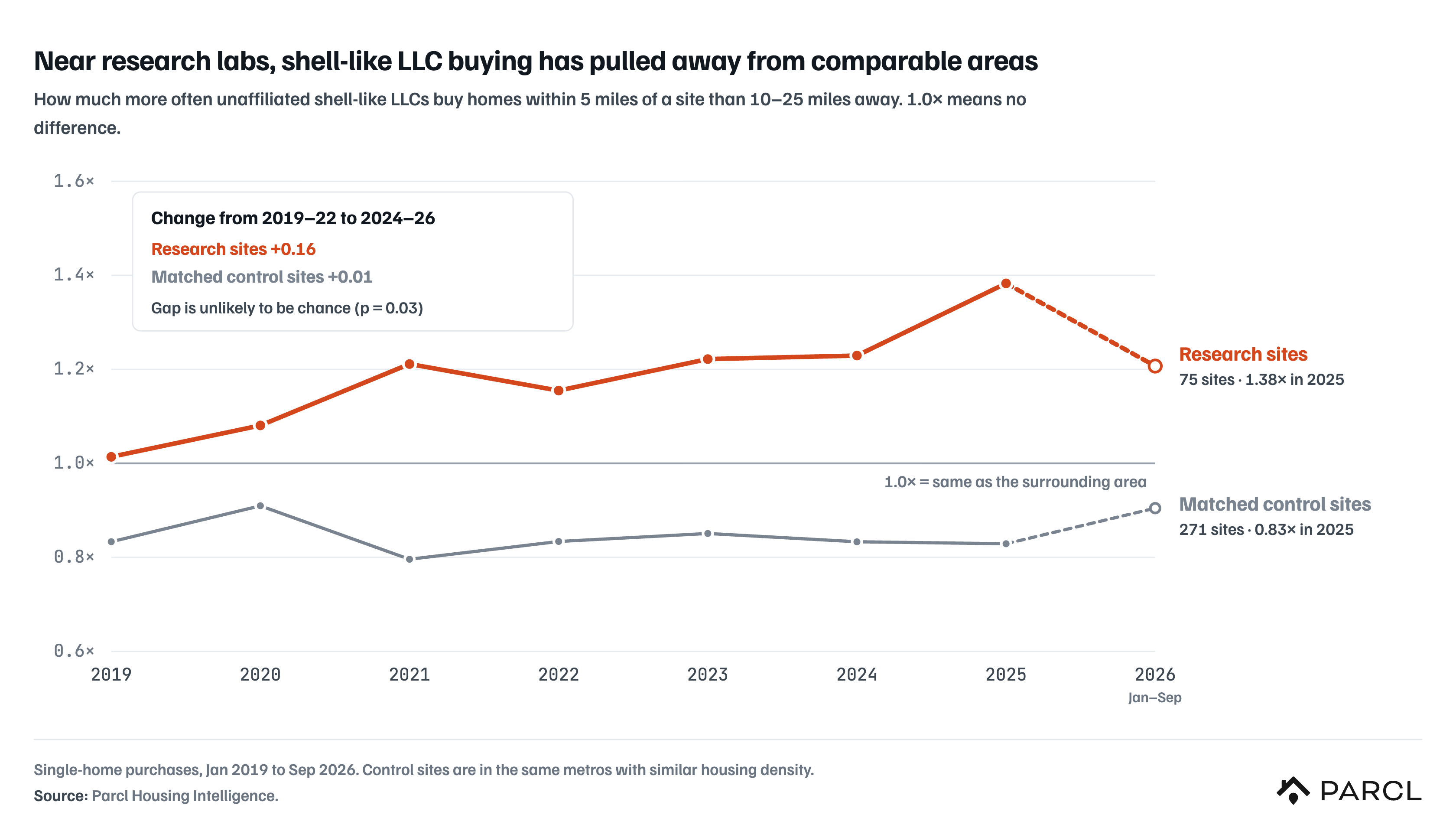
I then ran the same comparison around AI data centers and military bases. Neither shows a comparable rise. Near AI data centers, anonymous LLC buying stayed below the surrounding rate and held flat (-0.02). Near military bases it edged up only slightly (+0.06), well short of the rise near research facilities.
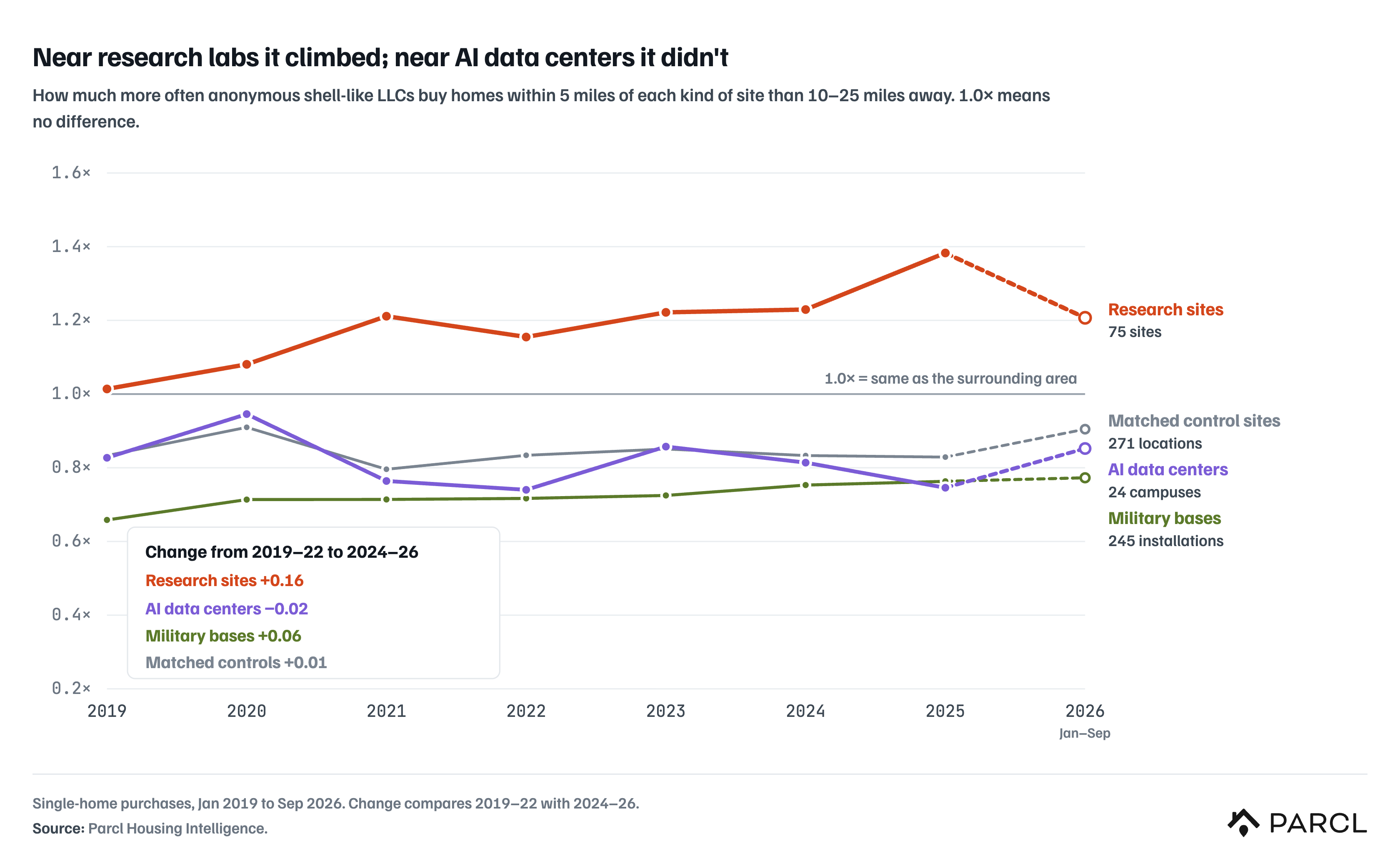
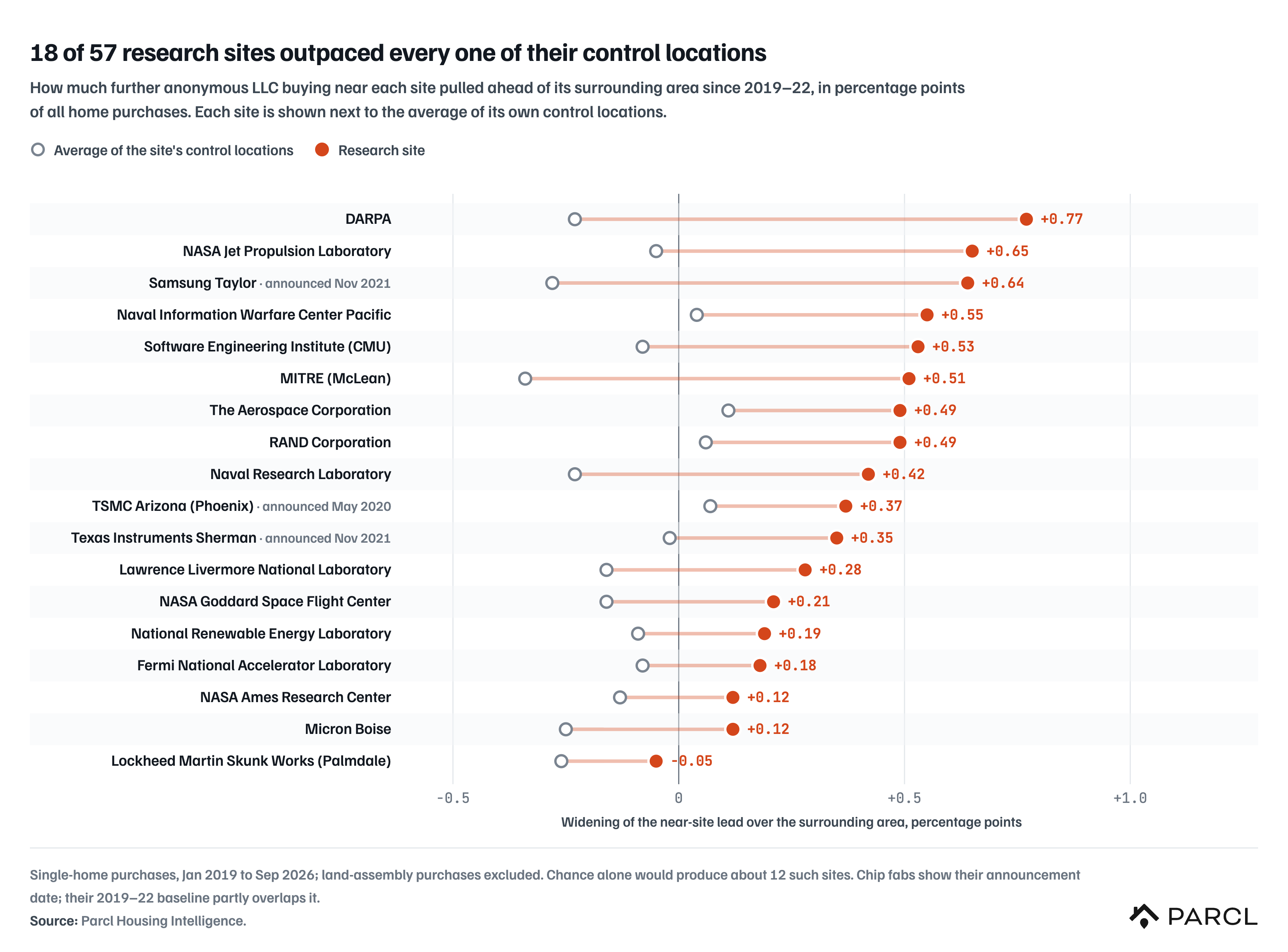
Within the R&D sites analyzed, 18 of 57 facilities outpaced every one of their own control locations.
At these sites, anonymous LLC buying near the facility pulled furthest ahead of the surrounding area, widening the gap by roughly 0.35 to 0.8 percentage points since 2019-22. Near NASA’s Jet Propulsion Laboratory, for example, anonymous LLCs made 1.6% of home purchases in 2024-26, more than twice the 0.7% in the surrounding area. The leaders:
- DARPA
- NASA’s Jet Propulsion Laboratory
- Samsung Taylor
- Naval Information Warfare Center Pacific
- Carnegie Mellon’s Software Engineering Institute
- MITRE (McLean)
- The Aerospace Corporation
- RAND Corporation
- Naval Research Laboratory
- TSMC Arizona
- Texas Instruments Sherman
Three of these are chip fabs announced partway through the 2019-22 baseline: TSMC Arizona (May 2020), and Samsung Taylor and Texas Instruments Sherman (both November 2021).
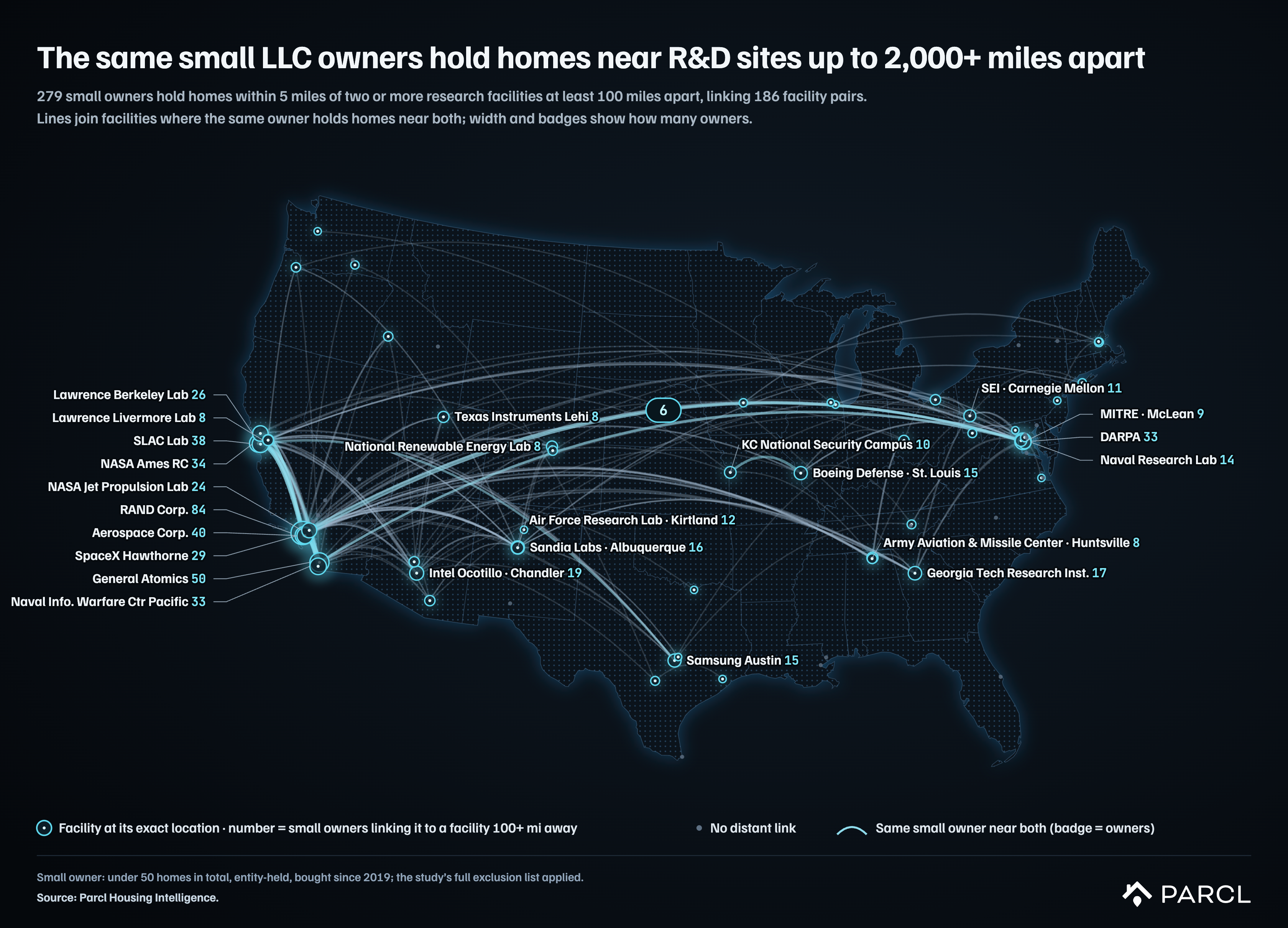
One of the most interesting parts is many of these same owners own separate properties next to R&D facilities hundreds to thousands of miles away.
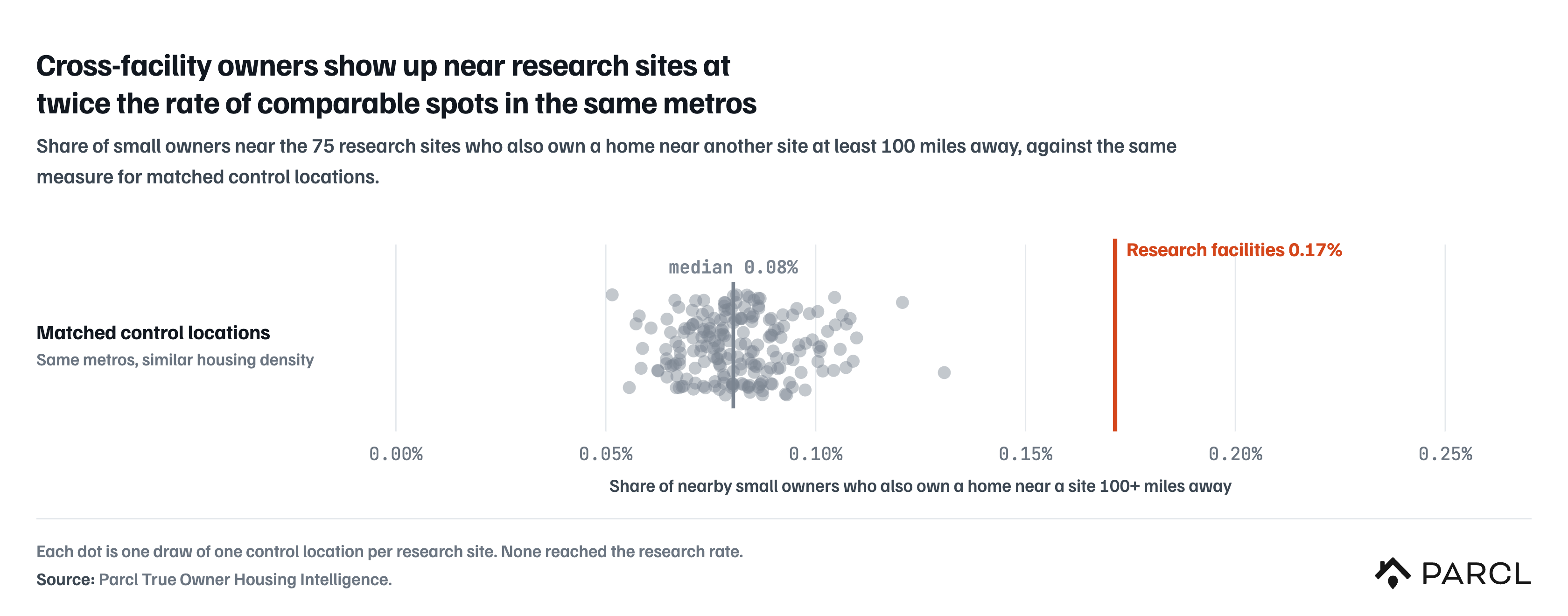
I mapped every small owner’s full portfolio (owners with fewer than 50 homes nationally) against every research facility. 279 owners with homes near these facilities also hold homes near a second facility at least 100 miles away, linking 186 pairs of facilities, about twice the rate at matched control locations in the same metros.
79 owners hold homes near facilities more than 1,000 miles apart.
35 of them hold homes near facilities more than 2,000 miles apart.
These small owners in proximity to the R&D facilities compared with control locations in the vicinity have twice the rate of multi site presence.
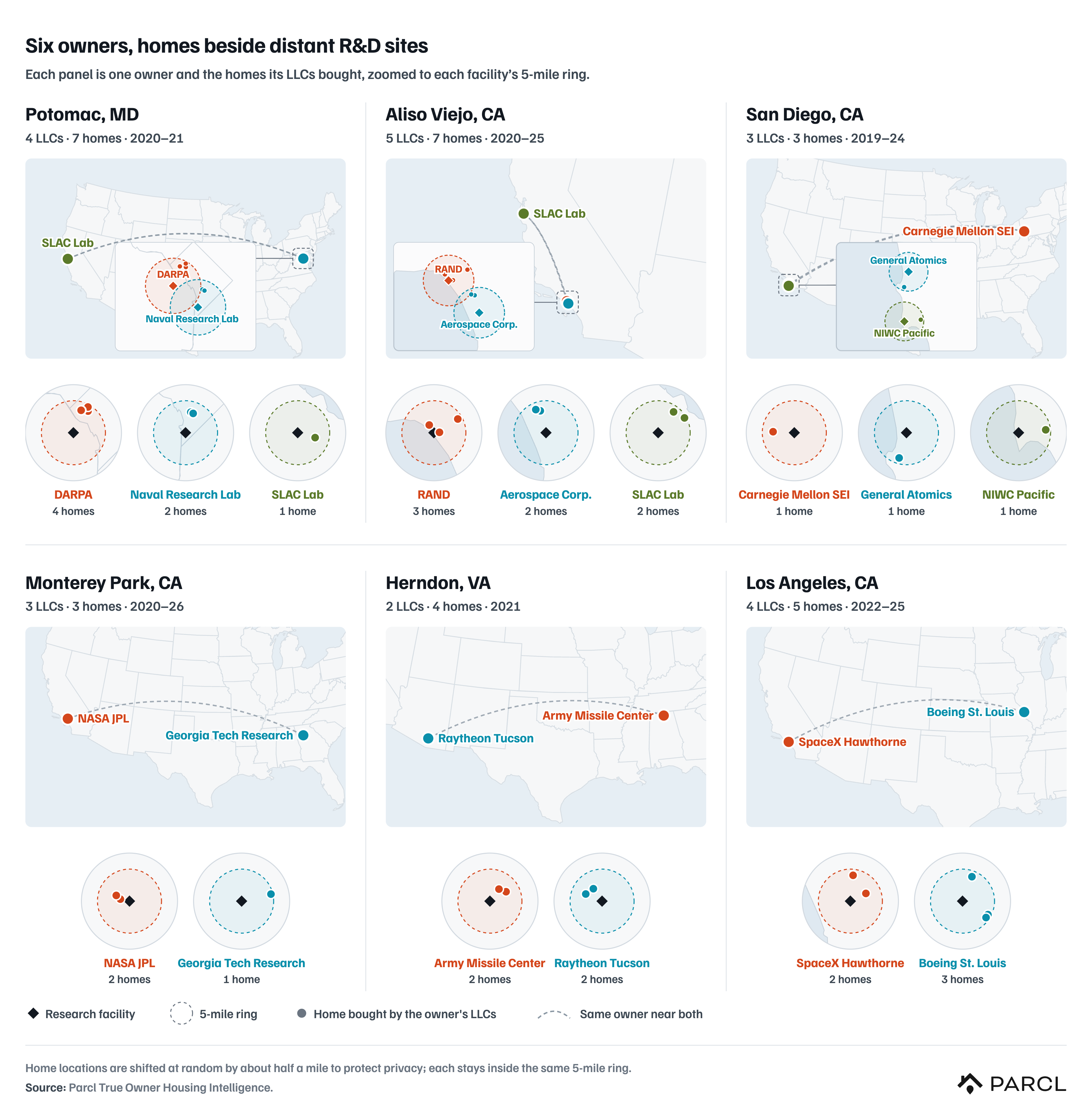
To see what these links look like on the ground, I pulled LLC purchases mapped to the same true owner within five miles of research facilities at least 100 miles apart. 6 of the 279 portfolios that meet this criteria are shown below.
An owner based in Potomac, Maryland bought seven homes through four LLCs in 2020 and 2021: four near DARPA, two near the Naval Research Laboratory and one near SLAC in California.
One based in Herndon, Virginia bought two homes beside the Army’s missile center in Huntsville and, seven months later, two beside Raytheon’s missile plant in Tucson.
Another, in Los Angeles, holds homes beside SpaceX in Hawthorne and Boeing’s defense campus in St. Louis.
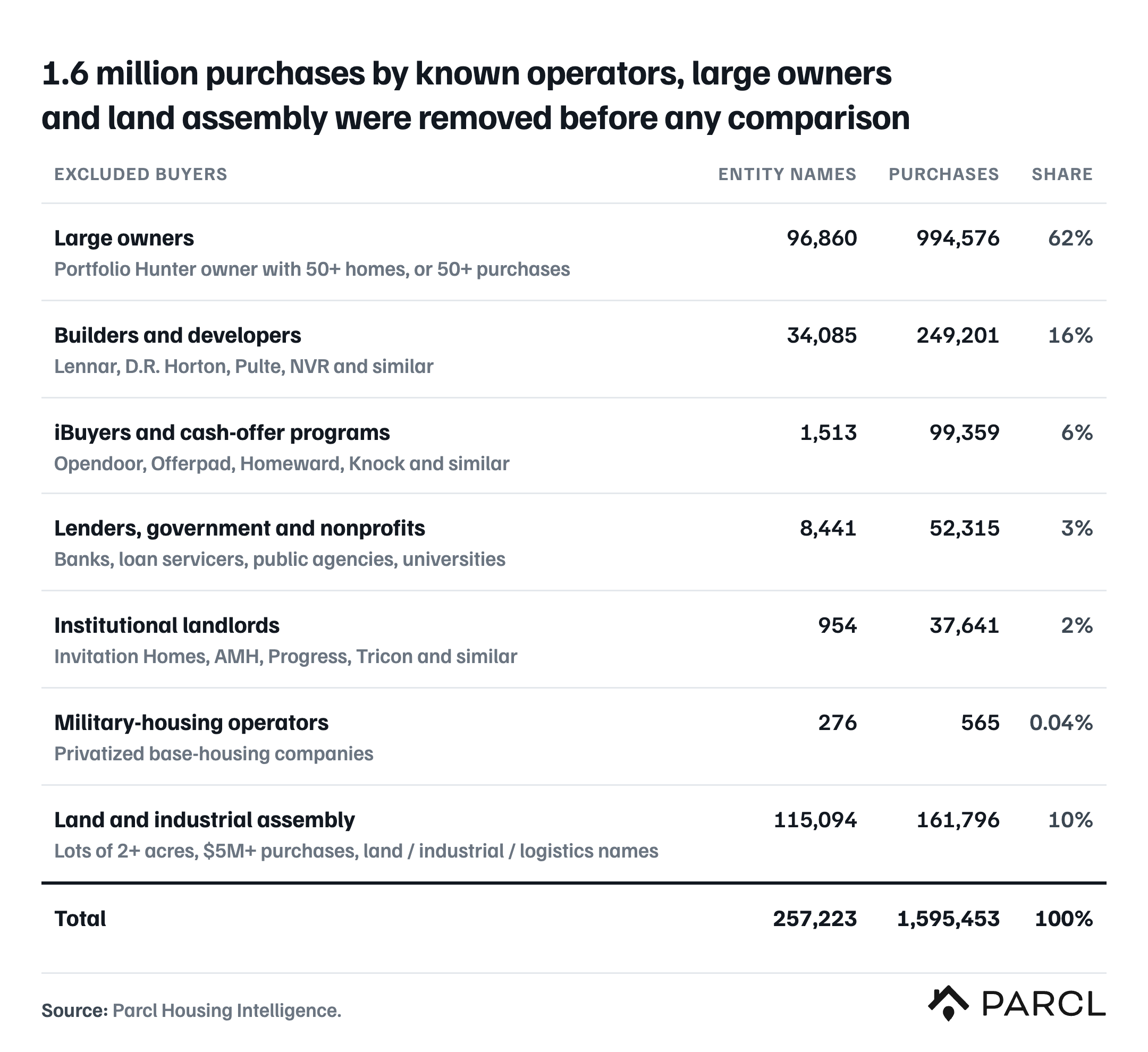
To isolate these actors, I first removed everyone whose identity and business are already known, plus purchases that look like land assembly rather than home buying. That was 1.6 million purchases made under 257,223 entities, shown below:
- large owners with 50 or more homes nationwide (96,860)
- builders and developers (34,085)
- iBuyers and cash-offer programs (1,513)
- lenders, government agencies and nonprofits (8,441)
- institutional landlords such as Invitation Homes and American Homes 4 Rent (954)
- privatized military-housing operators (276)
- land and industrial assembly: lots of 2+ acres, purchases of $5 million or more, or industrial, logistics and land company names (115,094)
What could explain it?
Thesis 1: Employers began protecting their people. Starting around 2020, companies and agencies may have encouraged researchers to hold homes through LLCs for privacy. But the rise spans many independent organizations at once: national labs, defense contractors, chip fabs, NASA. And it doesn’t explain why the same owners hold homes near facilities run by different organizations.
Thesis 2: Deliberate positioning near sensitive research. National-security interest in semiconductors, space and defense technology accelerated over this period. Domestic and international actors who already know how to obscure ownership would choose this kind of vehicle: a new LLC, cash, an opaque name.
Thesis 3: An ordinary investment strategy the exclusion rules missed. Research facilities sit in high-income job markets where small landlords increasingly hold each home in its own LLC. That can explain part of the pattern. It explains less of the cross-country picture that would be uneconomical for a smaller landlord: 96 owners hold homes near facilities more than 1,000 miles apart, and 41 of them near facilities more than 2,000 miles apart.
The pattern is consistent, statistically distinguishable from comparable locations, and growing.
From here, this activity is officially on watch.
Get in Touch
Parcl works closely with teams studying who owns, buys, and sells U.S. real estate. If this research or the underlying dataset interests you, email me directly at jason@parcllabs.com to learn more.
Author

Follow Us for More